 |
 |
 |
 |
EcoTipping Points
- How do they work?
- Leveraging vicious
cycles to virtuous - Ingredients for success
- Create your own
EcoTipping Points!
Stories by Region
- USA-Canada
- Latin America
- Europe
- Middle East
- South Asia
- Southeast Asia
- East Asia
- Africa
- Oceania-Australia
Stories by Topic
- Agriculture
- Business
- Education
- Energy
- Fisheries
- Forests
- Public Health
- Urban Ecosystems
- Water and Watersheds
Short Videos
- Saving a Coral Reef and Fishery (Apo Island, Philippines)
- Community Gardens Reverse Urban Decay (NYC, USA)
- Community Forests Reverse Tropical Deforestation (Thailand)
- Escaping the Pesticide Trap (India)
- Rainwater Harvesting and Groundwater Replenishment (Rajasthan, India)
How Success Works:
- Saving a Coral Reef and Fishery (Apo Island, Philippines)
- Community Gardens Reverse Urban Decay (NYC, USA)
- Community Forests Reverse Tropical Deforestation (Thailand)
- Escaping the Pesticide Trap (India)
- Rainwater Harvesting and Groundwater Replenishment (Rajasthan, India)

Human Ecology:
Principles underlying
EcoTipping Points

Stories from South East Asia
In-depth (based on site visits with extensive interviews)
- Philippines - Apo Island - Marine Sanctuary: Restoring a Coral-Reef Fishery - A marine sanctuary rescues a fishery and coral-reef ecosystem headed for collapse.
- Thailand - Trang Province - Taking Back the Mangroves with Community Management - Standing up to powerful interests to protect a commonly managed resource triggers a regeneration of society, economy and fishery.
- Thailand - Nakhon Sawan Province - Watershed Restoration with Agroforestry and Community Forest Management - The adoption of agroforestry farming and communally-managed forests empower impoverished villagers to optimize their resources, both natural and human.
- Thailand – Nonthaburi Province - Temple Reuses and Recycles, Refurbishes and Resells with Great Benefits for the Poor - A temple combines creative reuse and recycling, sustainable agriculture, and social programs.
- Vietnam - Dengue Hemorrhagic Fever, Copepods, and Biological Control of Mosquitoes - Community participation enlists a tiny predator of mosquito larvae to eradicate the dengue-fever mosquito, liberating a million people from the disease.
Capsule (shorter pieces which appear below)
- Indonesia - Borneo - Restoring a Rainforest - An orangutan rescue project provides valuable lessons for re-creating a rainforest.
- Indonesia - Bunaken National Park - Coastal Resource Management - Mangrove restoration and bamboo cultivation provide alternative livelihoods and wastewater treatment.
- Philippines - Marikina City - Urban Revival - A new mayor's master plan restores the livability and pride of an impoverished industrial city.
- Thailand - Pak Mun Dam - Experimental Dam Opening - Experimental reopening of the Pak Mun Dam gates reveals the social and ecological costs of megadams, and the benefits of rivers to the multiple communities who depend on them.
Indonesia – Borneo – Restoring a Rainforest
- Author: Regina Gregory
- Posted: July 2011
Willie Smits’ love for orangutans led him to create a rainforest for them. His innovative, integrative technique can serve as a model for similar projects elsewhere.
Smits, a native of Holland, conducted his dissertation research on the symbiosis between mycorrhiza fungi and the roots of tropical rainforest trees in Indonesia. In 1985 he began working as a conservation advisor to the Indonesian government and witnessed with great frustration the relentless destruction of Borneo’s rainforests. They were being clearcut for timber, then burned to make way for oil palm plantations. Smits’ sophisticated GIS system for monitoring orangutan habitat only made the problem more clear.
Smits had a life-changing experience in 1989, he says, when he saw the saddest eyes he’d ever seen. They were those of a baby orangutan in a cage, for sale at a market. When he returned later that day, the orangutan was on a garbage heap. Smits nursed it back to health, and soon he received other orphaned or confiscated orangutans to care for. In 1991, Smits founded the Borneo Orangutan Survival Foundation (BOS) and built a rehabilitation facility at the Wanariset forest research station. The object was to release the healthy orangutans back into the wild—but the wild was shrinking so rapidly that orangutans found it difficult to survive at all. The great Indonesian wildfire of 1997-1998, which burned 5.5 million hectares (including the underground coal), made the situation much worse.
In 2001, BOS began buying land from villagers at Samboja—badly degraded land where only alang-alang grass (Imperata cylindrica) grew. At that time it was a “biological desert,” according to Smits. Removing the rainforest had caused the disappearance of all the birds and other animals that lived there. It also led to less rainfall. People were paying about 22% of their income to buy water; crops failed repeatedly, leading to malnutrition and poor health. Unemployment was around 50%, and crime became a problem as well.
In all, BOS bought almost 1,900 hectares (4,700 acres) at Samboja. The land was divided into three zones: (a) an outer ring of sugar palms for fire protection and a source of renewable energy (ethanol) superior to palm oil; (b) a rainforest wildlife sanctuary; and (c) the BOS campus, which includes smaller sanctuaries as well as research and education centers and an eco-lodge. It is called Samboja Lestari, meaning Samboja Forever.
The first step was to plant fast-growing acacia trees to shade out the toxic alang-alang grass. About 1,300 other tree species were planted as well, at a rate of about 1,000 trees per day. With the help of Smits’ specially concocted organic fertilizer (organic wastes plus sawdust and manure and a microbial agent made from sugar and cow urine), plus fungi and bacteria that serve as natural “nutrient pumps,” the planted trees soon began to resemble a natural, diverse tropical rainforest. As of 2008, many of the trees were two stories tall. According to Smits, about 137 bird species have returned to the area, along with 9 species of primates. The microclimate has improved significantly, with temperatures 3 to 5° C lower than before and rainfall 25% greater. Humidity increased by 10% and clouds by 11.5%. Water is abundant again—enough for Samboja and its neighbors as well. Through an agreement with the local water supply company, Samboja Lestari helps provide water for 40,000 people.
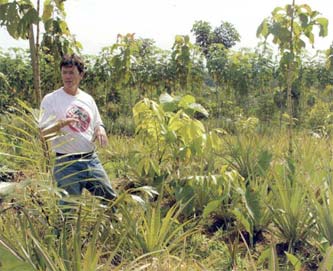
Smits with trees approximately 18 months old
Source: Jane Braxton Little. Regrowing Borneo, tree by tree. Scientific American Earth 3.0 18(5), 2008, p. 64-71.
Having observed how conservation projects often fail without local community support, Smits made sure that the 600 families of the local Dayak tribe were fully involved. The villagers are paid to work in the nursery, to plant and care for trees, and are allowed to grow food crops (e.g., pineapples, beans, ginger, bananas, papayas) between them. They also make money by growing food (mostly melons) for the orangutans. Thus they have an interest in preserving, rather than destroying, the rainforest. Overall about 3,000 jobs have been created. And this agroforestry system includes far more food than an average rainforest.
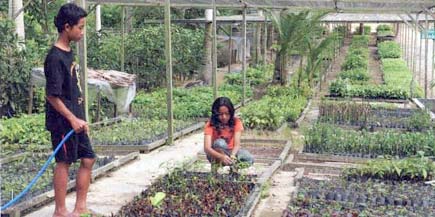
Local youth tend saplings in a nursery
Source: Jane Braxton Little. Regrowing Borneo, tree by tree. Scientific American Earth 3.0 18(5), 2008, p. 64-71.
Smits’ project is based on the principle of integrating people, profit, and planet. A project must be socially acceptable, economically feasible, ecologically sustainable, have a clear legal status, and be science-based, he says. Fairness, cultural values, and a system that is difficult to corrupt are also essential. Renowned scientist Amory Lovins remarked that "the ecosystem is beautifully and comprehensively integrated with the local economy, making the people so much better off. This may be the finest example of ecological and economic restoration in the tropics." If successful in the long term, the project could provide a very valuable model for rainforest rehabilitation all over the world.
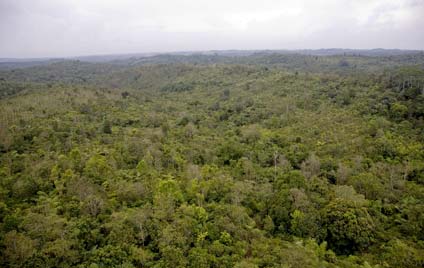
Aerial view of forest at Samboja Lestari
Source: http://www.orangutans.com.au/
Perhaps equally important to re-creating a rainforest is Smits’ discovery of the sugar palm. It happened by accident: the dowry requested for his Indonesian princess wife was six sugar palms. Smits wondered why so little was asked, since each tree was about the price of a chicken. He later discovered that besides fire protection, the sugar palm yields about 60 different useful products for the local people. On further investigation, Smits discovered the sugar palms provide three times more energy per hectare than other crops, on a sustainable basis. The sugar water can be tapped daily without harming the plant. The sugar palms at Samboja Lestari produce enough ethanol to generate 5 megawatts of electricity. Smits calls them “biological PV cells.”
See a 2009 presentation by Willie Smits at:
http://www.ted.com/talks/lang/eng/willie_smits_restores_a_rainforest.html
For more information on orangutan rescue projects, visit http://redapes.org
Indonesia - Bunaken National Park - Coastal Resource Management
- Author: Amanda Suutari
- Posted: May 2005
The site is Bunaken National Park, a series of Islands in Northern Sulawesi Province, Indonesia. This coastal resource management is based on models of mangrove community resource centers in Sri Lanka. With degradation of the mangrove forest in the national park, Yayasan Kelola (a local NGO) and the Mangrove Action Programme joined forces to establish the CCRC (Coastal Communities Resource Center). This is intended as a space for coastal resources protection practitioners to gather for workshops and seminars to promote appropriate technologies and livelihood alternatives for coastal communities, with showcases on the following:
- Improved fuel-efficient cookstoves (relying on charcoal from coconut shells, which coconut farmers tend to throw away as waste instead of a resource), which have been found to save 10% of a fishing family's monthly income that would be normally spent on fuel needs.
- Eco-bamboo treatment facility - -this was designed to provide sustainable alternatives and supplements to fishers' and farmers' income. Bamboo grows fast and so is easily renewable, and use of this in place of mangroves relieves pressure on mangroves and rainforest. The bamboo is treated by environmentally-benign borax and boric acid which keeps it insect - and rot-resistant. The bamboo has been used in construction of the CCRC and orders are being placed for it already.
- Wastewater Gardens - -this is a variation on the theme of phytoremediation (water purification using plants).
- A permaculture demonstration.
- A showcase of other local materials such as the nyapah palm used for thatch.
The project is in the first phase of a two-phase plan to rehabilitate a disused shrimp pond beside CCRC, by organizing planting by villagers and elementary schoolchildren (the remaining 10 hectares had been unsuccessfully planted three times by local government and forestry department).
Services/benefits recovered: income and economic incentive to preserve a resource, food, fuel, waste treatment, storm protection, water regulation, knowledge systems, education, values, sense of place, ecotourism
It should be noted that this is still a pilot project in the early stages, so the benefits are mostly "potential," although probably more developments have taken place since the last published report.
Philippines - Marikina City - Urban Revival
- Author: Amanda Suutari
- Posted: May 2005
Since 1787, "Mariquina," as it was known before the entry of the US, located in metropolitan Manila, is a 2,150-hectare area bordered by mountain ranges and a river. Known for its large shoe industry, this otherwise faceless town had been a dirty city with haphazard shantytowns lining a blackened, polluted river, with no proper garbage disposal, and whose apathetic population was jaded by years of neglect by authorities.
This situation began to change when incoming mayor Marides Fernando came in with a vision to revamp the city in the model of Singapore, which has been praised for its efficient services, clean air and water, and civic responsibility. Fernando believed in the "Broken Window Pane" theory, which describes how citizens will become alienated from dilapidated surroundings, losing their motivation to maintain them (and the corollary that a new sense of cooperation will develop if there is a concentrated effort to rehabilitate them).
A Marikina City Development Authority (MCDA) was created to come up with a master plan which ranged from services to infrastructure to environment and legislation. The initiatives include:
- A riverside development plan, with a river cleanup program, public education about protecting the river, and the creation of pathways, parks and other public places. This made the riverside safer and cleaner, which encouraged people to spend leisure time there. There was also an economic development strategy with the creation of a commercial area near the river, with bars, restaurants, and stores. Cultural and historic heritage were also promoted with the preservation of a historic shrine, and a shoe museum. Ample space has been provided for parks, playgrounds, and promenades.
- A settlement office was set up to provide adequate shelter for shanty dwellers. Those living in slums by the river were relocated to a model resettlement area. The city's ultimate goal is to have a squatter-free city. One way to do this was under the Community Mortgage Program, which helps residents to own the lots that they occupy.
- Strict zoning regulations were enforced, which complemented the relocation of shanty dwellers. The zoning also was aimed at illegal vendors who were seen as obstructions on pedestrian areas. At the same time, a public market was set up, and its safety standards are being regularly tested.
- A waste management program was set up, with a materials recovery facility, garbage collection services, and enforceable anti-littering laws.
- Education program and supplies fee coverage for eligible elementary and high school students.
- A program to encourage payment of taxes by offering discounts on government services for those who fully pay their taxes. The MCDA's master plan, modeled on Singapore, may seem somewhat top-down and draconian, and the effects of its policies on relocated shanty dwellers and "illegal street vendors" bears more investigation. Nevertheless, its vision stressed that proper services and enhanced quality of life was possible as long as citizens cooperated and acted responsibly as well. The city has won multiple awards, and is attracting attention from other municipalities interested in taking similar approaches in other cities, which has contributed to a strong sense of pride of Marikina natives.
For more information visit the Philippine Center for Investigative Journalism.
Thailand - Pak Mun Dam - Experimental Dam Opening
- Author: Amanda Suutari
- Posted: May 2005
This case is a good illustration of a system crossing thresholds into new stability domains, both when a dam is built and when it is removed. While dams are being decommissioned increasingly in the US, experimentally reopening gates of a controversial dam in a developing country - -and studying what happens - - is less common.
The Pak Mun Dam (PMD) was completed in 1994 by the Electricity Generating Authority of Thailand and funded by the World Bank, despite opposition by 6,000 families who were displaced by the project as well as efforts by local and foreign non-governmental organizations (NGOs) such as the International Rivers Network.
Yielding somewhat to 10 years of resistance by villagers, the government opened the gates for 1 year and commissioned Ubon Ratchathani University to study the effects of the opening of the dam. The study found numerous things, including:
- Some 152 species of fish returned to the Mun River, 134 of which are migratory (who travel from the Mekong to live, feed and spawn), including the appearance of the endangered Mekong Giant Catfish.
- Of the 74 types of fishing gear normally used, 22 types had been made obsolete by the dam; after the gates' opening, fishers began using these obsolete types again (fishing gear is directly related to status, dignity and cultural pride for fisherfolk).
- Villagers reported being better fed.
- Vegetation along the Mun River began to recover, much of which was used for food, herbs, fish food, gear, rope, timber, household appliances and ceremonies.
- Land was being used for riverside gardens again.
- The number of inter-village conflicts decreased.
- Household incomes went up. In 1990, 32.7% of residents in the target area were below the poverty line; this figure went up to 62.5% in 2000, and fell to 57.6% in 2001.
However, the Thai government has since ignored the urging of NGOs and villagers to keep the gates open and decided to close them, and said they will continue to do so for 8 months a year.
For more information visit Rivers Watch and a Ubon Ratchatani University study.